Rearing a baby African Grey isn’t just cute photos and first words — it’s the single window of time that shapes almost everything about who your bird becomes. Get the early feeding transitions and first training steps wrong, and you can end up with a bird carrying behavioral baggage for decades. Get them right, and you’re setting up a calm, confident companion for the next 50-plus years.
If you’re an experienced bird keeper taking on a young Grey for the first time — congratulations, and buckle in. This isn’t a task to take lightly, but it’s also not as intimidating as it sounds once you understand the actual sequence your bird needs to go through.
This guide focuses specifically on the two things most first-time rearers get wrong: the weaning progression and the first foundational training steps. For cage setup, full diet lists, and health monitoring, I’ve linked to dedicated guides throughout so you’re not reading the same advice twice.
Table of Contents
Why the First Year Shapes Everything
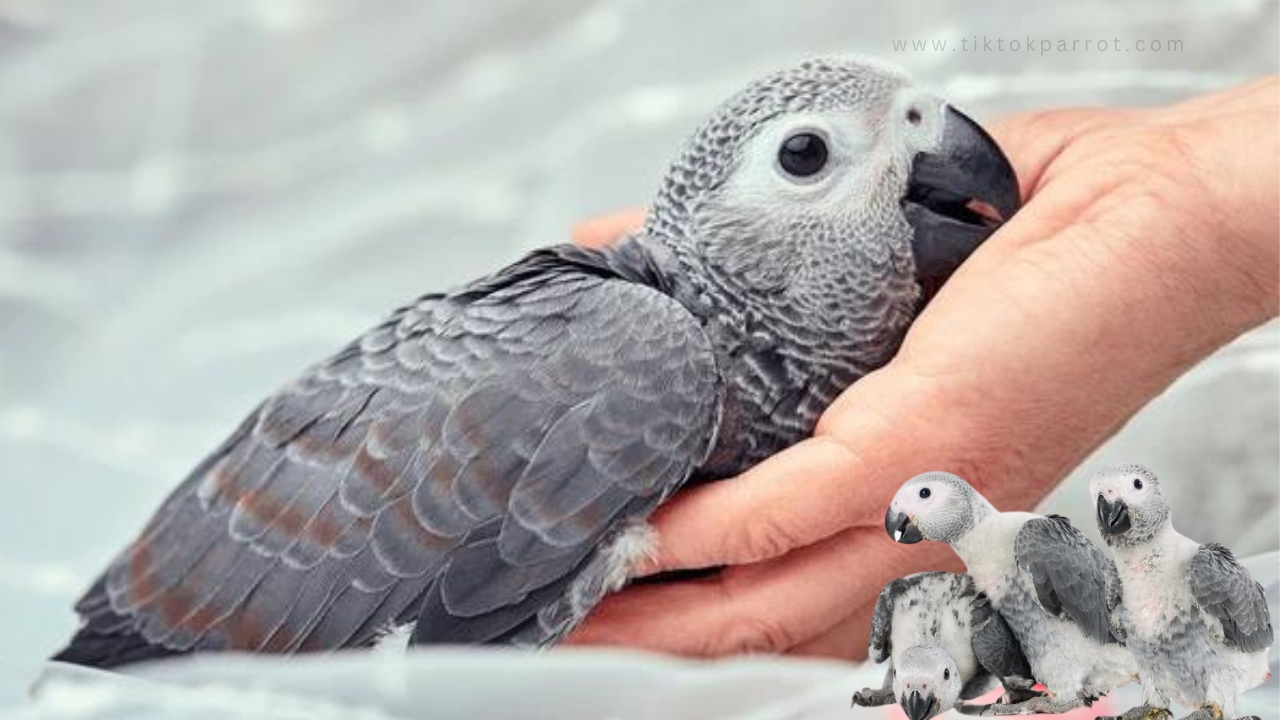
Improper rearing during the early months tends to surface later as behavioral problems — excessive fear, poor bite inhibition, or difficulty bonding — and those patterns are far harder to undo once they’ve set in than they would have been to prevent.
That’s the real reason careful rearing matters so much: it’s not about raising a “perfect” bird, it’s about not accidentally teaching your Grey the wrong lessons during the window when it’s absorbing everything.
The Weaning Journey: From Formula to Solid Food
Weaning is a gradual process, not a switch you flip — rushing it is one of the most common mistakes new rearers make.
Stage 1: Hand-Fed Formula
Very young chicks are entirely dependent on hand-fed formula delivered by syringe, similar to how a human infant starts on milk alone. This stage requires precise temperature, consistency, and feeding schedule — if you’re hand-feeding from this early stage yourself rather than receiving an already-weaned bird, it’s worth reading a dedicated chick-rearing resource alongside this one, since formula feeding has its own safety considerations.
Stage 2: Pureed Fruits and Vegetables
Once your chick is stable on formula, you can begin introducing pureed raw fruits and vegetables by hand or spoon. This mirrors an infant’s move from milk to soft food — it’s a low-risk way to introduce new flavors and textures while keeping vitamin and mineral content intact.
Stage 3: Bird Seeds and Bite-Sized Pieces
When your young Grey is comfortable with semi-solid purees, introduce bird seeds to familiarize them with new textures and tastes. From there, move to small, bite-sized pieces of raw fruits and vegetables. This stage is about building food confidence and independence, not about locking in a final diet — pellets and a fuller, balanced menu come later as your bird matures.
Throughout this process, avoid rushing any single stage just because your chick seems ready — a slower, steadier transition reduces the risk of digestive upset and food refusal down the line.
Foundational Commands: Teaching “Up,” “Down,” and “No”
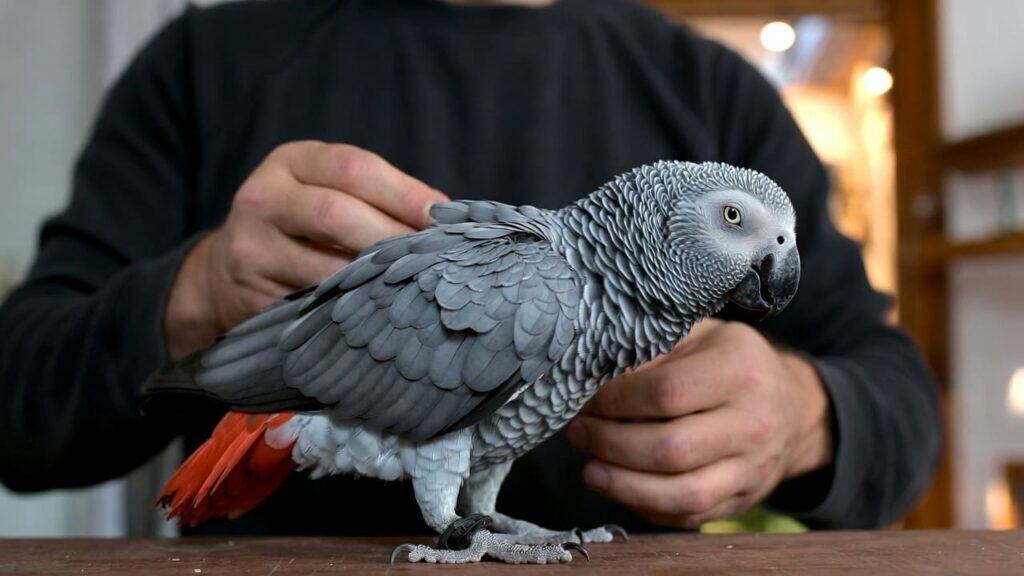
Once your baby Grey is settling into its new environment, early training can begin with three foundational commands:
- “Up” — the step-up cue, taught by gently pressing near the bird’s lower chest/feet while giving the verbal command, rewarding any forward movement toward your hand.
- “Down” — the step-down or “stay put” cue, used to redirect your bird calmly off your hand or a surface.
- “No” — a calm, consistent signal for undesired behavior, most effective when paired with immediately withdrawing attention rather than raising your voice.
Consistency and repetition are what actually make these commands stick — a young Grey that hears the same cue paired with the same expected action, every time, will respond far faster than one trained inconsistently across different family members.
Encouraging Your Baby Grey to Talk (Without Rushing It)
African Greys typically don’t begin talking until around 18 months old, and pushing a young bird to “perform” before it’s ready usually backfires. In the meantime, simply talk to your Grey often and naturally — narrate what you’re doing, use consistent phrases, and treat conversation as normal even though you won’t get a response yet. Your bird is listening and storing vocabulary well before it ever repeats a word back to you.
Also worth noting: young African Greys are naturally shy and don’t like being handled or moved around more than necessary. Resist the urge to take your bird out of its cage constantly “to work on talking” — calm, consistent voice exposure does more good than frequent handling at this stage.
For techniques specifically aimed at building vocabulary once your bird is a bit older and more settled, see teaching your African Grey parrot to talk.
Gentle Socialization for a Naturally Shy Species
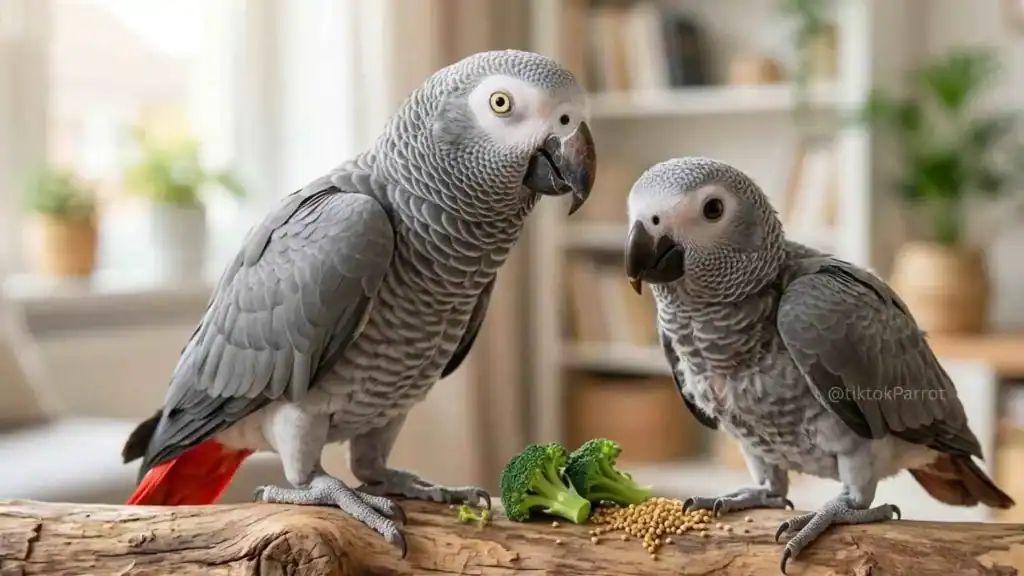
Interaction with you and, gradually, with other people is essential for a well-adjusted adult Grey — but because these birds are instinctively cautious, socialization needs to be introduced slowly. Bringing a young Grey into a room full of unfamiliar people too early can set back trust-building significantly.
If children are part of the household, age-appropriate supervision matters just as much as pacing — see is your child ready for an African Grey parrot? for guidance on introducing kids safely. And if you’ve just brought a young Grey home and want a broader settling-in framework beyond weaning and training, new Grey parrot? 7 ways to get off to a great start covers the first days and weeks in more depth.
Rounding Out the Picture
Rearing a young African Grey well also depends on a few things beyond this guide’s scope:
- Cage setup and safe home prep — see things you need to know about an African Grey parrot’s cage
- Full-spectrum nutrition once weaned — see calcium-rich foods for African Grey parrots for one of the most commonly overlooked nutritional gaps
- Health monitoring — see signs of illness in an African Grey parrot to know what’s normal versus what warrants a vet visit
- Understanding growth milestones — see stages of development of an African Grey parrot for what to expect from hatching through adulthood
Frequently Asked Questions
At what age do African Grey parrots start talking?
Most begin around 18 months, though this varies by individual bird. Earlier silence doesn’t mean your Grey isn’t learning — vocabulary is often absorbed well before it’s repeated aloud.
How do I know when my baby Grey is ready to move from purees to solid food?
Look for consistent, confident eating of pureed food without refusal before introducing seeds and bite-sized pieces. Rushing this transition can cause digestive upset.
Why shouldn’t I handle my baby African Grey too much?
African Greys are naturally shy and cautious by instinct. Excessive handling or movement during the early weeks can increase stress and slow down trust-building rather than speed it up.
How long does it take to teach basic commands like “up” and “down”?
With daily, consistent repetition and positive reinforcement, most young Greys begin responding reliably within a few weeks, though every bird learns at its own pace.
Final Thoughts
Rearing a young African Grey is genuinely demanding — but the payoff is a bird that trusts you, communicates with you, and shares your home for decades. Take the weaning stages slowly, keep training consistent, and let socialization happen at your bird’s pace rather than yours. The patience you invest now is what your Grey will carry with it for the rest of its very long life.
If this blog post has helped you, please share it with your family and friends who might also find it helpful. If you love African Greys, join our community of Grey owners! You can meet other owners, share tips and learn from each other.
You might like to read these as well 🙂
African Grey Parrot Male or Female? (Determine Gender of African Grey)
How can you determine the age of an African grey parrot?
Breaking the Myths: The Truth About African Grey Parrot Eggs
African Grey Parrot Price & Owning Cost
Types of African Grey Parrots
How to Breed African Grey Parrots
Unlock the Secrets of Choosing the Perfect African Grey Parrot
Is Your African Grey a Jealous Bird? Here’s What You Need to Know!
African Grey vs Amazon – A Comparison of Two Popular Pet Birds
The Battle of the Birds: African Grey Parrot vs Crows
What To Do If Your Parrot Is Choking, something stuck in the throat?
The Importance of a Cage for Your African Grey Parrot
The Surprising Benefits of Owning an African Grey Parrot
Surprising facts about African Grey Parrots
African Greys 101: Avoid These Common Mistakes and Keep Your Parrot Thriving!
For more useful content about African grey parrots, you can subscribe my site with your email to get notification upon publishing a new blog, the subscribe box you can see on the right side of this page. Also if you get an alert on your web browser while browsing my site, allow it and that will also give you an alert whenever I publish a new blog. 🙂
Stay safe and much love!


Hey there! 🐾 Looking for top-notch pet supplies or anything on Amazon?
Support our site by shopping on Amazon through our this referral link, it will not cost you extra!
Your purchases on Amazon can help us continue providing valuable content.
Thank you for your support! 🛍️